
Robert Christgau “The Last Critic”
It’s been six months since I’ve written a word for this site, an inconsequential data point to quite literally every person on earth except for me, who’s maintained a metronomic publishing cadence for five years and who’s relied on that metronome as an organizing constant. As for why I broke my streak, there are many reasons. I got busy. I got tired. I ran out of compelling subjects. But the actual reason—or at least the biggest reason—was something that happened to me in the summer of 1984.
That summer, on the very first day of sleepaway camp, my bunkmate inserted a cassette into his stereo boombox and pressed play on “Bohemian Rhapsody” by Queen. Six minutes later, my life would never be the same. It was not as though I instantly loved the song (I was more confused than anything) or that I became a massive Queen fan (though I briefly did). It was more that Queen’s grand rock opera in miniature signaled something profound and profoundly unsettling to me about pop music. Possibilities beyond the radio. Vastness beyond my grasp.
Now on the one hand I already knew this. I was old enough to realize that my parents owned a menagerie of LPs in our living room cabinet by artists I’d not ever heard on the radio (Barbra Streisand, Englebert Humperdinck, etc.). Similarly, I understood that the songs I heard on WPLJ and WNEW were simply the singles from albums which consisted mostly of non-singles. And yet it took me ten years of life and “Bohemian Rhapsody" to finally confront the incomprehensibly of the pop musical universe.
Later that August, when I returned home from camp, still staggering from this revelation, I asked my parents to take me to Tower Records with the singular goal of determining exactly how vast the universe actually was. Well, it turned out that the answer was “pretty fucking vast.” Tower Records on West Fourth Street in Manhattan spanned multiple floors—two for Rock and Pop and another just for Jazz and Classical. Still years before the CD revolution, there were rows upon rows of cassettes and vinyl LPs, of which I recognized less than .1% of the names and titles. It did not take me long to officially confirm what “Bohemian Rhapsody” had only suggested—that the musical universe was much bigger than I had previously imagined. As for its incomprehensibility, however—I spotted a glimmer of hope.
Perched high atop Tower’s small but nevertheless intimidating (to a ten year old) collection of books I found “Christgau’s Record Guide: Rock Albums of the Seventies.” Immediately—reflexively—I felt a pang of excitement. Something told me that the answer to my question lay inside that paperback tome. So I reached up, took it off the shelf and made a bee line for “Q,” where I located a short and quizzical summation of Queen’s “A Night at the Opera.” Just 85 words and a terse letter grade: B-. It was everything I needed to know and also confirmation that I knew nothing at all. But most importantly, it was the promise that somebody, somewhere, somehow could help me comprehend the incomprehensible. And apparently that man’s name was Robert Christgau.
Over the next ten years I—previously a very slow and doubly resistant reader—chewed on, devoured, spat up, and re-ingested Christgau’s Record Guide. By the time I was twelve I had traded in most of my baseball card collection for a full blown record buying habit. And by my teen years, dutifully following Christgau’s lead, I was scoffing at my parents’ effete James Taylor appreciation and their parochial Little River Band fandom. Meanwhile, with Christgau’s guidance, I began to seek out and play (on repeat) records from bands who I’d never heard on the radio, who my friends had never heard of and who my parents would not, could not possibly understand. At the same time, I was beginning to hear connections—formal relationships as well as commonalities in my own tastes—which, uncoincidentally, mirrored those of my sherpa, the self-proclaimed “Dean of American Rock Critics.”
Around the time of my Christgau awakening—maybe even a year before—I had started reading Bill James’ annual “Baseball Abstract.” In 1984, I saw no correlation between these authors other than that they both provided me with a joy of reading that I’d not found previously with “The Hardy Boys” or “Encyclopedia Brown.” And yet, all these years later, the connection seems so obvious. Both men of a certain age were savants in their chosen subject as well as their literary form. Both wrote with a distinctive character and narrative flair, but, most of all, with concision. Like Christgau, Bill James was able to make sense of the unfathomable. He quantified the unquantifiable. He compared the incomparable. His biases sounded objective. His opinions forged a canon.
In fact, I think it’s fair to suggest that our modern, American obsession with list-making and Mount-Rushmore-etching starts somewhere in the early Eighties with Bill James and Bob Christgau. Bill had his top ten lists for every position. Bob had his annual Dean’s list of albums. Before the two men, there were of course Hall of Fame votes and MVP ballots and batting leaders and Billboard charts. But with the release of Christgau’s first Record Guide in 1981 and James’ first bound Baseball Abstract in 1980, we graduated from the ancient realm of tastes and opinions to the Moneyball world of knowledge and analysis. In more ways than I can count, James and Christgau were the doulas of contemporary “take culture”—witty, evidence based, irrefutable and (more than occasionally) infuriating.
At least that’s what I told myself. My teens and early twenties were spent leaning on Christgau to help me navigate the world of popular and (mostly) sub-popular music—The New York Dolls. Parliament. Television, The Feelies. Public Enemy. Where my friends would “zig,” I would necessarily follow Christgau’s “zag.” Christgau not only shaped my musical tastes, he helped define them—a fact that betrays my own sense of independence and which I therefore only reluctantly admit. But it is also true, and maybe more to the point, to say that his Guides provided me with a lifetime of musical discovery and pleasure. And for that I have spent most of my life feeling a sense of debt and gratitude to the man and his writing.
So much gratitude, in fact, that three years ago, over coffee with a friend who makes documentary films, I said something like: “It recently occurred to me recently that not only has Christgau has written more about music than anyone to ever walk the planet and it follows that he has probably listened to more music than anyone to ever walk the planet.” My thought—more a curious musing than a confident claim—was not particularly revelatory. But the question right beneath it was. I wanted to understand how he did it—the time, effort, the skill, the cost and the benefit. I was so intrigued by the question, in fact, that I told this friend I’d be interested in helping produce a documentary about Christgau if he thought there was a “there” there.
Within twenty-four hours, my friend called me back to let me know that he had a friend—with whom he’d worked on documentaries previously—who’d interned for Christgau in the late Nineties. More to the point, this friend of my friend had made a short documentary about Christgau while at NYU. And most to the point, this friend of my friend was still very much connected to Christgau and was eager to figure out how my offhanded offer might become a reality. And that is kind of, sort of how I—somebody who’d never worked on, much less produced, much less directed a film—found myself in the East Village of New York in early 2023, trying to convince THE Robert Christgau that he’d make an amazing subject for a feature length documentary.
That was three years ago. Since then, I’ve spent many days with Bob and his (not surprisingly) amazing partner, Carola Dibbell. I’ve interviewed everyone from Randy Newman and Thurston Moore to Boots Riley and Colson Whitehead. I’ve spent weeks hunting down archival images and months obsessing over milliseconds of footage. I’ve written briefs and notes and more notes for editors and animators and composers. I’ve begged strangers for their participation and support. I’ve lost sleep over how every frame looks and sounds. All the while, not knowing if I was up to the task of telling this story. All the while returning to two basic questions: How do we make the best movie possible with the resources we have and how do we ensure that the movie find its audience?
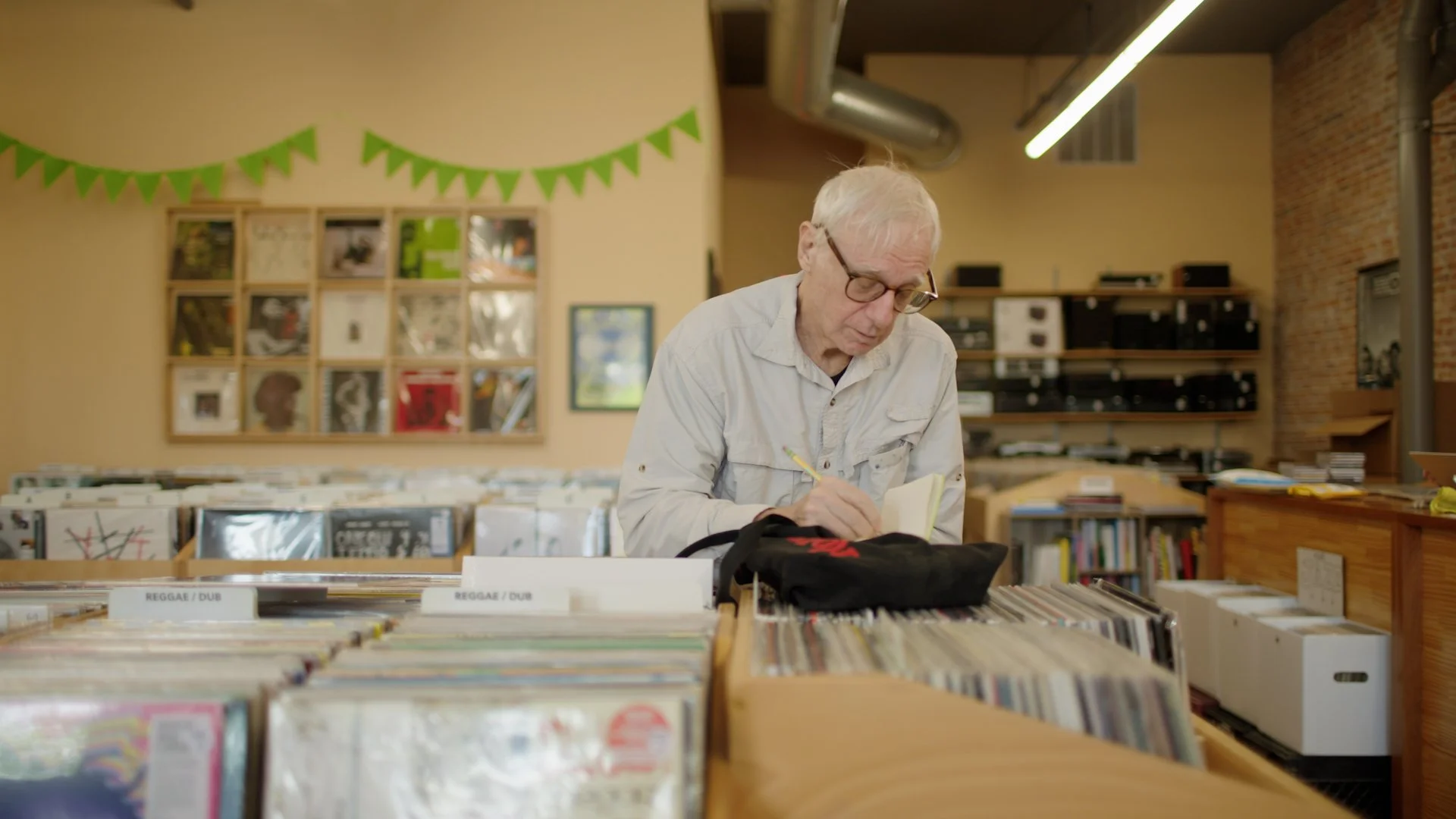
And now, here we are. It’s late January and The Last Critic will be premiering in just a couple months, followed by a limited “festival run” (look at me using movie industry speak) before hopefully making its way into rep theaters and then, finally, onto streaming services. Candidly, I’m surprised I’ve made it this far—not to the end of production (I’ve always been good at finishing what I started) but rather to the point where people seem excited to see the film. I share this less as an offhanded indictment of my own skill or the subject or the team involved but rather because, throughout this long gestation, I’ve often wondered whether this doc really (all caps) MATTERS.
When I learned that the film had been accepted into the SXSW Documentary Competition, I had to chuckle at the seriousness of the other competing films—movies about deep personal tragedy and triumph and global politics and worldly issues. In comparison, our movie sounded minor, if not quaint. On the other hand, compared to those other, possibly more esteemed movies, The Last Critic also sounded sweet and fun and entertaining and—if I dare say—compelling. Compelling in that it is a story about aging and love and obsession and, specifically, about aging and love and obsession with music.
And that’s the thing—music is the thing. I know of course that there are more existential matters—family, love, birth, death, justice and freedom, to name but a few. But also I cannot think of that many things in life which are so personal, so deeply held and so uniquely defining as one’s relationship to music. What would my life be without Television’s “Marquee Moon” or The Replacements’ “Let it Be,” or Aretha Franklin’s “Young, Gifted and Black” or Van Morrison’s “Veedon Fleece”? It’s hard to say except that my life is so much richer because of those records and thousands more—many of which I discovered through Christgau.
As much as it is about a very particular man and his equally particular written opinions, The Last Critic is ultimately about one man’s sixty year relationship to music, how it shaped his life and, in turn, how it touched the lives of (literally) millions who he alternately inspired and/or infuriated. And in a very small way but also in a massive and deep way, that sounds important to me.
Important enough that—to this day—Christgau garners a loyal, paid online subscriber base that waits with bated breath on his capsule reviews and offhanded dismissals. Important enough for his name to be dropped across every corner of the internet as shorthand for journalistic arrogance and dogmatism and—most of all—Heavy Metal loathing. Important enough to break my five year writing streak on this website. Important enough for me to dedicate those years trying to figure out who is Robert Christgau? What does “Robert Christgau” signify? How does he do it? How does he listen to so much and write so much—every hour of every day of every month of every year for fifty-plus years, doing the same work from the same place with the same approach while everything else changes around him? And maybe most specifically and personally—why does he hate Queen so much? Forty-two years after I first asked myself that question, I got the answer.
The Last Critic will premiere in the Spring of 2026. I hope you’ll check it out, when it screens near you or when it finally lands on a streaming service.